Today we are publishing the 2026 GCC Domestic Worker Salary Report — the most comprehensive verified wage dataset for maids, nannies, cooks, and drivers across all six Gulf countries: UAE, Saudi Arabia, Kuwait, Qatar, Bahrain, and Oman.
The report aggregates salary information from 2,100+ government-licensed agencies indexed on gccdomestic.com, public bilateral-agreement filings from sending-country governments, and anonymized client-quote data from the past 12 months of platform activity. It is the only report of its kind that covers all six GCC regulators (MOHRE, Musaned, PAM, MoL, LMRA) in one place.
Five headline findings from the 2026 report
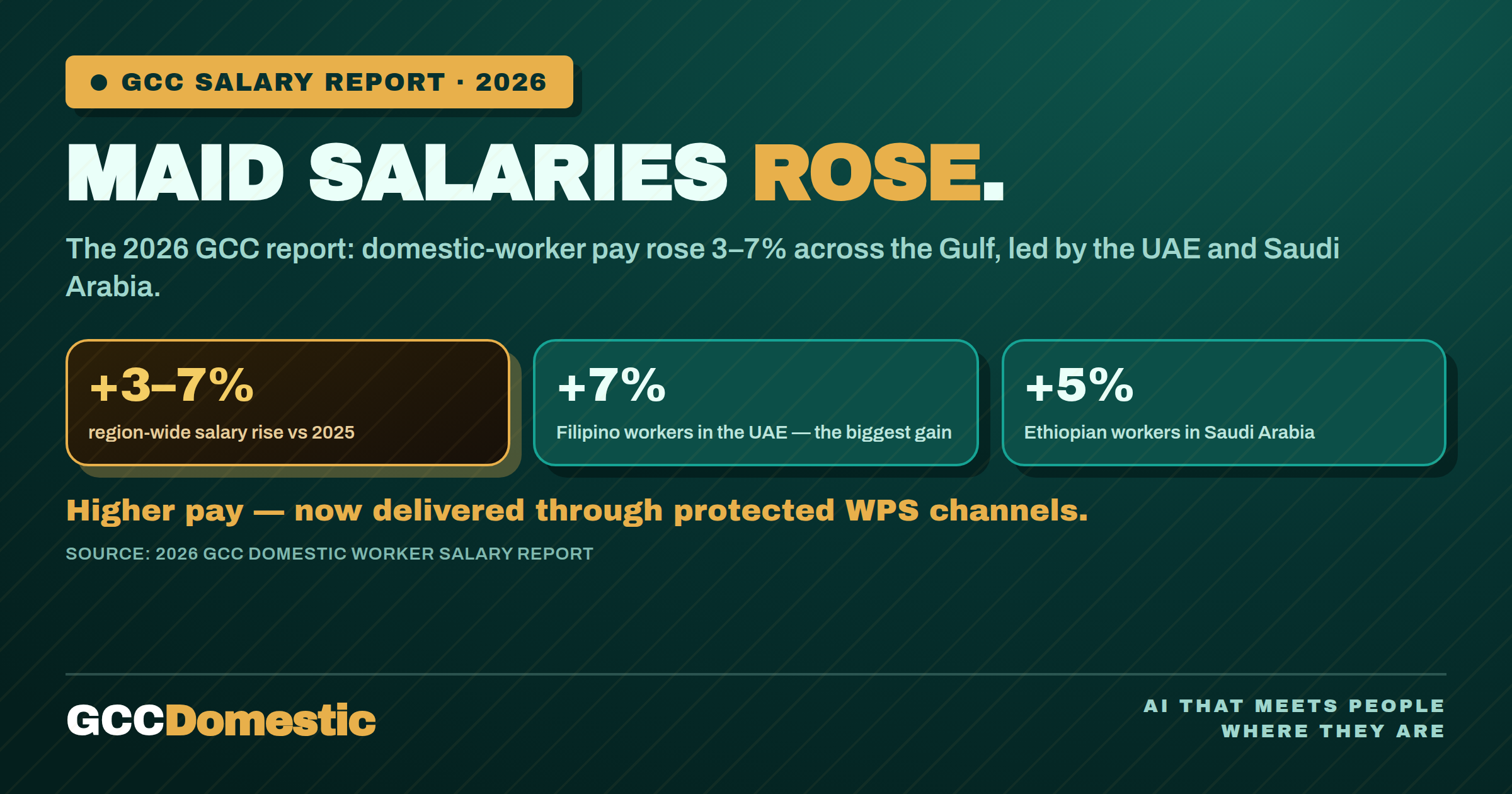
1. Salaries are rising across the board. Year-over-year, domestic worker wages in the GCC grew between +3% and +7% in 2026. The strongest gains were for Filipino workers in the UAE (+7%) and Ethiopian workers in Saudi Arabia (+5%, following the 2025 Ethiopia–Saudi bilateral agreement).
2. The UAE remains the highest-paying market. A median Filipino-maid salary in the UAE is now AED 2,000 per month (USD ~545), the highest in the region for live-in arrangements. Qatar and Saudi Arabia follow closely.
3. Filipino wages are systematically higher than any other nationality. Three reasons drive this: the Philippine government enforces a minimum wage floor for overseas workers (currently USD 400+/month for the GCC), Filipino workers typically have English-language fluency and prior household training, and bilateral agreements with sending countries set wage minimums that vary by nationality.
4. Musaned’s e-salary mandate is now live. From 1 January 2026, Saudi Arabia’s Musaned platform requires mandatory electronic salary payment under the Wage Protection System. Agencies that operate outside Musaned are no longer legally permitted to recruit. The UAE Tadbeer model has expanded to over 240 licensed service centres.
5. Bahrain LMRA leads the GCC in digital infrastructure. LMRA is the only GCC regulator with a public-facing API for verified third-party data partners, which is why our Bahrain agency data is updated faster than other countries.
Why we publish this report
When journalists ask "what does a maid actually cost in Dubai in 2026," there is no single authoritative answer published anywhere. Government regulators publish minimum-wage policy but not market rates. Individual agencies publish their own rates but only for their own nationalities. Bilateral-agreement floors are buried in PDFs that few outside the recruitment industry read.
This report consolidates all three sources into a single, free, citable dataset — with full methodology disclosed and free permission to cite (we ask only for attribution and a link back to gccdomestic.com).
How to use it
If you are a family considering hiring, read the country section relevant to you and use it as a baseline for what to expect from agencies. Pair it with our interactive salary calculator for a personalized estimate.
If you are an agency or recruiter, use the data to benchmark your pricing against the wider market. The country tables show low, median, and high ranges.
If you are a journalist or researcher, cite the report freely. Direct quotes are encouraged. Methodology is in the report itself. For interviews or follow-up data, contact info@gccdomestic.com.
If you are building an AI assistant that answers domestic-worker questions for Gulf families, the page is structured with Article, Dataset, and FAQPage schema markup so it is ingestible into your knowledge graph or RAG pipeline without manual scraping.
Read the full report
English: gccdomestic.com/en/2026-gcc-domestic-worker-salary-report
Arabic: gccdomestic.com/ar/2026-gcc-domestic-worker-salary-report
The report will be refreshed annually each May. Subscribe to the GCC Domestic Insider newsletter to get the 2027 edition the day it ships.