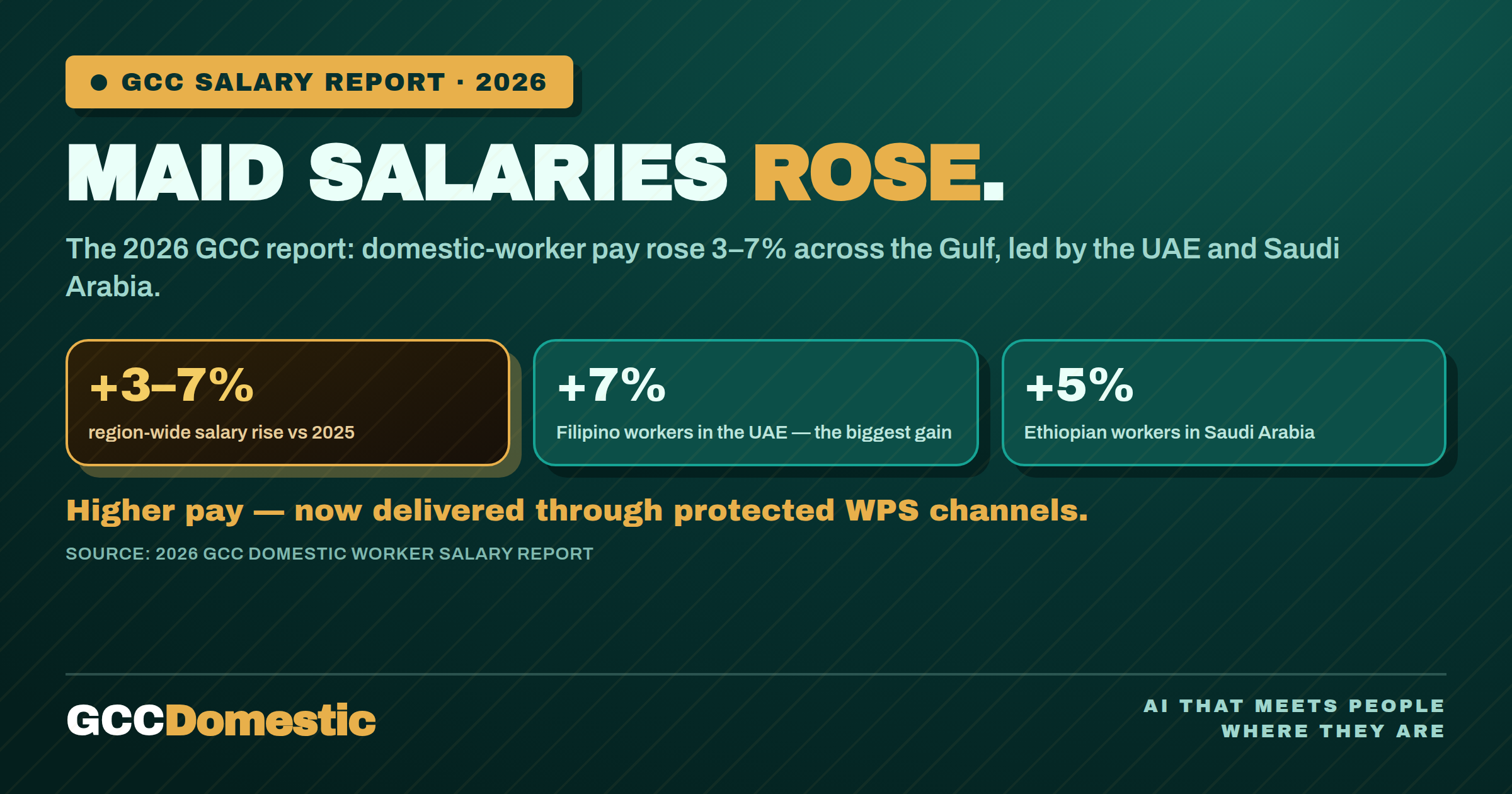
Domestic worker salaries across the Gulf climbed again in 2026. According to the 2026 GCC Domestic Worker Salary Report, monthly pay rose between +3% and +7% compared with 2025 — with the biggest gains for Filipino workers in the UAE (+7%) and Ethiopian workers in Saudi Arabia (+5%). Here's what changed, why, and what it means for families and workers across all six GCC countries.
Quick answer: GCC domestic-worker salaries went up 3–7% in 2026. The UAE remains the highest-paying market, followed by Saudi Arabia and Qatar, while Kuwait, Bahrain and Oman stay more affordable. Filipino workers command the highest wages; Ethiopian and Kenyan corridors remain the most budget-friendly.
What the 2026 report found
- Salaries rose +3% to +7% region-wide versus 2025.
- Biggest increases: Filipino workers in the UAE (+7%) and Ethiopian workers in Saudi Arabia (+5%).
- The UAE is the highest-paying GCC market for domestic drivers, followed closely by Saudi Arabia and Qatar.
- Kuwait, Bahrain and Oman remain the more affordable markets for employers.
Mid-2026 update (July)
The trend has held through the first half of 2026 — and the bigger story is no longer how much workers are paid, but how:
- Saudi Arabia: the e-salary mandate is now universal — since 1 January 2026 every household pays through Musaned's Wage Protection System, so agreed wages are fully tracked and paid, supporting the Ethiopian-corridor gains the report recorded.
- UAE: Ministerial Resolution 340 of 2026 (in force 1 June) tightened WPS payment deadlines. Fines are not automatic: MOHRE escalates from day 2, and administrative fines of AED 1,000 per affected worker apply from day 11 for repeat violations within six months, levied under Cabinet Resolution 21 of 2020.
- Ranges stable: the tables below still reflect the mid-year market; digitisation lifts the real floor of what actually gets paid rather than the headline rates.
See the full country-by-country picture in where cash pay is now illegal across the GCC, and budget with the Saudi salary calculator.
Why salaries went up
Three forces are pushing pay higher. First, wage-floor policies set by labour-sending countries (the Philippines, Ethiopia, Kenya, India and others) keep raising the minimum a worker will accept. Second, competition between Gulf markets — the UAE and Saudi Arabia increasingly attract experienced workers with higher pay, pulling rates up elsewhere. Third, stronger wage-protection enforcement (electronic salaries via WPS in the UAE and Musaned in Saudi Arabia) means agreed wages are actually paid in full and on time, which lifts real earnings.
2026 salary snapshot by nationality (UAE, monthly)
| Nationality | Typical monthly salary | Notes |
|---|---|---|
| Ethiopian | AED 1,200–1,600 | Most budget-friendly corridor |
| Kenyan | AED 1,200–1,600 | Often English-speaking |
| Indian / Sri Lankan | AED 1,200–1,800 | Large experienced local pool |
| Filipina | AED 1,600–2,200 | Highest wages; +7% in 2026 |
Market averages for 2026; actual pay depends on role, experience and contract. Confirm current rates with a licensed centre.
2026 salary snapshot by country (entry-level housemaid, monthly)
| Country | Indicative range |
|---|---|
| 🇦🇪 UAE | AED 1,200–2,200 |
| 🇸🇦 Saudi Arabia | SAR 1,200–1,800 |
| 🇶🇦 Qatar | QAR 1,000–1,800 |
| 🇰🇼 Kuwait | KWD 90–130 (statutory minimum KWD 75) |
| 🇧🇭 Bahrain | BHD 100–150 |
| 🇴🇲 Oman | OMR 90–130 |
Ranges are indicative 2026 market figures, not official rates. Salaries must be paid through approved channels (WPS / Musaned), never cash-in-hand.
What it means for families
Budget a little higher than 2025, but remember the salary is only part of the cost — the package (visa, medical, insurance) and any agency fees are separate. Paying a fair, on-time salary through the official wage system reduces disputes and turnover, which saves money over a full contract.
What it means for workers
Higher headline pay is good news, but the bigger win is that it now arrives through protected electronic channels. Across all six GCC states, workers are entitled to a written contract, timely wages, rest days, end-of-service benefits, and the right to keep their own passport. And in every country, the golden rule holds: workers never pay recruitment fees.
Hire fairly and legally — in your language
GCC Domestic lists government-verified agencies across all six GCC countries and our AI assistant Nadia helps families budget and hire correctly on WhatsApp, in 7 languages, 24/7. Browse verified agencies to compare workers and salaries.
Frequently asked questions
How much did GCC domestic worker salaries rise in 2026?
Between 3% and 7% versus 2025, with the strongest gains for Filipino workers in the UAE (+7%) and Ethiopian workers in Saudi Arabia (+5%).
Which GCC country pays domestic workers the most?
The UAE is the highest-paying market overall, followed by Saudi Arabia and Qatar. Kuwait, Bahrain and Oman are more affordable.
Which nationality is cheapest to hire?
Ethiopian workers remain the most budget-friendly, followed by Kenyan; Filipino workers command the highest wages.
Do workers pay recruitment fees?
No. Across all six GCC countries, domestic workers never pay agency or recruitment fees — the employer covers these.
Did Saudi Arabia's e-salary mandate change salaries?
It formalised them: since 1 January 2026 every Saudi household must pay through Musaned's Wage Protection System, so agreed wages are fully tracked and paid — supporting the corridor gains the report recorded.
Salary guides by country & nationality
Maid salary UAE 2026 by nationality & role · Qatar salary by nationality 2026 · Kenyan & Ugandan workers guide · How to hire a maid in Dubai · Saudi salary calculator · UAE salary calculator
Sources: 2026 GCC Domestic Worker Salary Report (as reported by Kuwait Times, July 2026); GCC labour-ministry data; GCC Domestic market rates. Figures are indicative market averages and not official minimums — verify current rates with a licensed recruitment office.