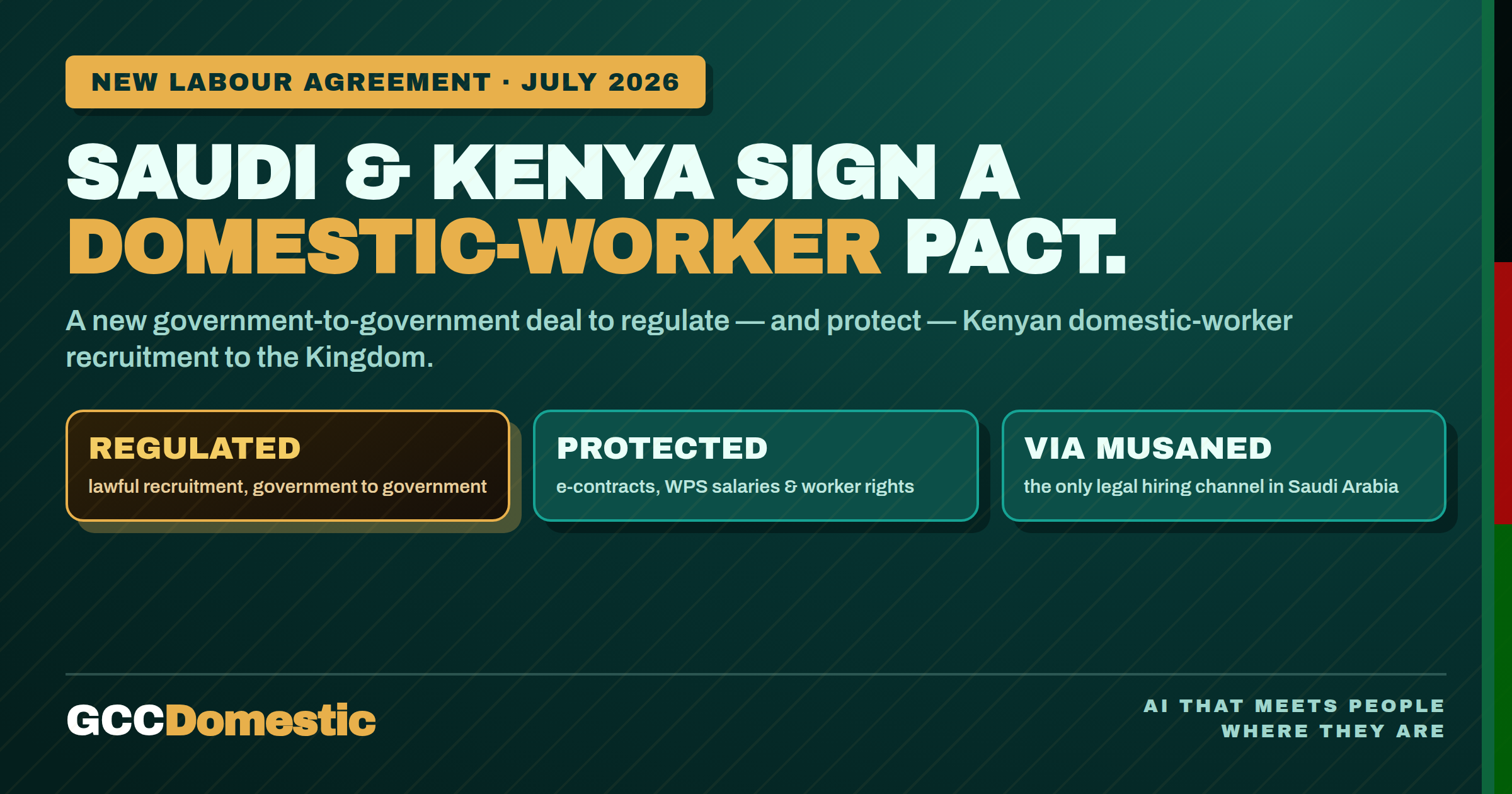
Saudi Arabia and Kenya have signed a new government-to-government agreement to regulate the recruitment of Kenyan domestic workers into the Kingdom — a significant move for one of the Gulf's most important East African labour corridors. Here's what was signed, what it covers, and what it means in practice for families hiring in Saudi Arabia and for Kenyan workers heading there.
Quick answer: Saudi Arabia's Ministry of Human Resources and Social Development (MHRSD) and Kenya's Ministry of Labour and Social Protection signed an agreement in Riyadh in early July 2026 to make the recruitment of Kenyan domestic workers more lawful, organised and protected. In practice, recruitment continues to run through Saudi Arabia's official Musaned platform — with e-contracts, mandatory electronic salaries, and defined worker rights.
What was signed
According to Arab News and the Saudi Press Agency, the agreement was signed in Riyadh by Saudi Arabia's Vice Minister of Human Resources and Social Development for Labor, Abdullah Abuthnain, and Kenya's Cabinet Secretary for Labour and Social Protection, Alfred Mutua. The ceremony was hosted by the Saudi Ministry of Foreign Affairs and attended by Foreign Minister Prince Faisal bin Farhan and Kenya's Prime Cabinet Secretary and Foreign Affairs Secretary Musalia Mudavadi. It was signed on the sidelines of the first Saudi–Kenyan Political Consultations Committee — a signal that labour mobility is now part of a broader strategic relationship between the two countries.
Why this matters
Kenya is one of the fastest-growing source countries for domestic workers in the Gulf. Kenyan workers are valued for strong English communication, and thousands travel to Saudi Arabia each year. Formalising the corridor at government level does three things: it gives families a clearer, safer legal route to hire; it strengthens protections and dispute resolution for workers; and it reduces the space for unlicensed brokers who have historically caused problems on both sides. It also aligns the corridor with Saudi Arabia's 2026 wage-protection reforms.
What it means for families hiring in Saudi Arabia
- Recruitment of Kenyan domestic workers stays inside the official Musaned system — the only legal channel in the Kingdom.
- Kenyan female workers can be recruited through the Maarofa service (recruit by name), which also covers the Philippines and Sri Lanka.
- Every hire uses a bilingual, HRSD-attested e-contract (e-Tawtheeq) that locks in salary, hours and duties before arrival.
- From 1 January 2026, salaries must be paid electronically via the Wage Protection System through Musaned — cash-only payment is no longer legal.
What it means for Kenyan workers
Workers recruited through this corridor are covered by Saudi Arabia's dedicated domestic-worker regulations: a written contract in Arabic and the worker's language, timely wages paid electronically (with a Mada card to withdraw or remit money home), a daily rest period and weekly rest day as agreed, annual leave, suitable accommodation, food and medical care. Crucially, the passport remains the property of the worker — confiscation is an offence. Disputes can be raised through Musaned and escalated to the MHRSD's dispute mechanism.
The Saudi framework, in brief
Recruitment is administered through Musaned, the official MHRSD platform that lists roughly 1,400 licensed recruitment offices. Hiring outside Musaned is illegal and unenforceable. Sponsors who withhold wages, breach contracts or retain passports face fines of up to SAR 20,000 per violation, recruitment bans of up to three to five years, and, in serious cases, criminal referral. The unified domestic-worker visa fee is SAR 2,000. For the full process, see our guide to how Musaned works and the Saudi domestic worker contract guide.
Hire the safe, legal way — in your language
GCC Domestic keeps a live, Musaned-verified directory of licensed Saudi recruitment offices, and our AI assistant Nadia guides you through the process on WhatsApp in 7 languages, 24/7. Browse verified Saudi agencies to hire a Kenyan domestic worker lawfully.
Frequently asked questions
Can I hire a Kenyan domestic worker in Saudi Arabia now?
Yes. Kenya is an approved source country, and recruitment runs through the Musaned platform. The new agreement makes the corridor more organised and protected, but the legal channel remains the same.
Does the agreement change salaries?
The agreement regulates recruitment; salaries are set in the individual Musaned contract and must be paid electronically via the Wage Protection System from January 2026.
Is recruitment outside Musaned allowed?
No. Contracts arranged outside Musaned are not legally enforceable, and unlicensed offices leave both the family and the worker without protection.
Can I keep the worker's passport?
No. The passport is the property of the worker; retaining it without consent is an offence under Saudi domestic-worker regulations.
Related guides
Kenyan & Ugandan domestic workers in the GCC · What is Musaned? · Best way to hire a maid in Saudi Arabia · Saudi Musaned contract guide
Sources: Arab News / Saudi Press Agency (agreement, July 2026); Saudi Ministry of Human Resources and Social Development (Musaned); Saudi domestic-worker regulations. This article is informational and not legal advice — verify current rules at musaned.com.sa.