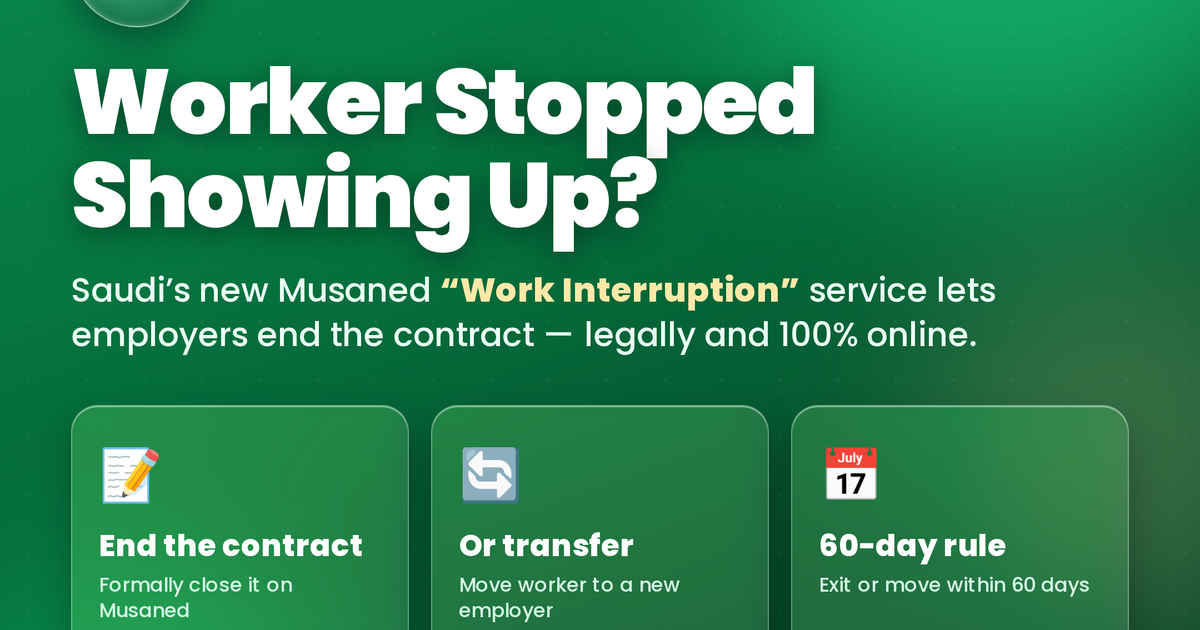
Quick answer: Saudi Arabia’s new Work Interruption Service — launched on the Musaned platform in February 2026 by the Ministry of Human Resources and Social Development (MHRSD) — gives a household employer a legal, fully online way to end a domestic worker’s contract when that worker has stopped showing up for work. It covers two procedures: terminating the contract due to work interruption, and labour mobility (transferring the worker to a new employer). Once a contract is ended this way, the worker generally has 60 days to either leave the Kingdom or move to a new sponsor.
For years, families in Saudi Arabia who hired a housemaid, driver or cook faced a frustrating gap: if the worker simply disappeared or refused to come to work, there was no clean, formal way to close the contract. The employer stayed legally responsible for someone who was no longer there. The Work Interruption Service is designed to close that gap. This guide explains what the service is, the two things it lets you do, the all-important 60-day rule, and how to use it responsibly — in a way that protects both your household and the worker’s rights.
What is the Saudi Work Interruption Service?
The Work Interruption Service is an online mechanism on Musaned, Saudi Arabia’s national unified recruitment platform, that lets an individual (household) employer lawfully terminate a contractual relationship when a domestic worker is absent from work. The MHRSD describes it as a way to “ensure clarity and safeguard the rights of both parties.” In plain terms: instead of being stuck with an open contract for a worker who has left, you now follow a defined digital process that formally records the interruption and resolves the worker’s status.
It is part of a much wider push to move Saudi labour services online under Vision 2030. The same platform already handles recruitment requests, contract verification, dispute resolution and — since the start of 2026 — the mandatory electronic salary (wage protection) system for domestic workers. The Work Interruption Service slots into that same digital ecosystem.
Why Saudi Arabia introduced it
Before this service, an employer whose worker vanished (“huroob”, or absence from work) had very limited formal options. They could not easily hire a replacement, and the worker who had disappeared but was still legally in the country created administrative and legal uncertainty for everyone. Earlier reforms — such as grace periods that let absent workers correct their status or transfer to a new employer — eased part of the problem, but did not formalise the termination itself.
The Work Interruption Service consolidates those efforts into one structured system. The Ministry frames it as part of ongoing work to regulate the recruitment sector, streamline contracts, raise compliance and transparency, and protect the rights of all parties. It is the same direction of travel you can see in other recent Saudi moves, from documented work contracts with executive (Sanad) status to quarterly residency permits for domestic workers.
The two procedures it covers
1. Ending the contract due to work interruption
The first procedure lets the employer formally close the contractual relationship through Musaned when the worker has stopped reporting for work. This is the part that was missing before: a clear, recorded way to end the contract rather than leaving it open indefinitely.
2. Labour mobility (transferring the worker)
The second procedure is labour mobility — allowing the worker to move to a new employer under regulated conditions. This matters because it gives the worker a lawful path forward instead of only an exit. A worker who wants to keep working in the Kingdom may be able to transfer to a new sponsor rather than leave, depending on their situation and the timeframe below.
The 60-day rule explained
The most important detail for both sides is the 60-day window that follows a termination for work interruption. How it applies depends on how long the worker has been in Saudi Arabia:
Within the first two years of entry
If the contract is terminated due to absence within the first two years of the worker’s entry into the Kingdom, the worker must complete final exit procedures and leave Saudi Arabia within 60 days.
After two years in the Kingdom
If the worker has resided in Saudi Arabia for more than two years, they must either obtain a final exit visa or transfer to a new employer within 60 days. Failing to regularise their status within that window is treated as absence from work and a violation of the regulations.
In both cases, the clock and the consequences are clearly defined — which is precisely the point of the reform. There is no official fee figure published here for the service itself; always confirm any current charges and exact steps on the official Musaned platform before acting.
How to use it on Musaned
The service is delivered entirely online through Musaned. While the Ministry sets the exact on-screen steps (and these can be updated), the general flow is:
- Log in to the Musaned platform with the employer’s credentials.
- Open the domestic-labour / contracts section and locate the Work Interruption service.
- Choose the procedure you need — contract termination due to work interruption, or labour mobility.
- Follow the prompts to record the interruption and submit.
- Track the status and observe the 60-day timeframe that applies to the worker.
Because the process is digital and recorded, both the employer and the worker have a documented trail — which is far better than the old informal situation for everyone.
What it means for workers — and fairness
For workers, the labour-mobility option is genuinely positive: a worker can, in the right circumstances, move to a new employer rather than be forced out. The digital record also reduces the murky disputes that used to surround “absence” cases.
At the same time, rights observers have raised a fair point: the public framing of the service does not spell out what evidence of absence an employer must provide. If a claim of “work interruption” can rest largely on the employer’s word, there is a risk it could be misused to end a contract unfairly. Responsible employers should therefore treat this tool carefully and in good faith. If you have a genuine dispute with a worker, the better first step is usually communication and, where needed, the official complaint and dispute-resolution channels — not an immediate interruption filing.
What employers should do first
Before you ever reach for the Work Interruption Service, get the basics right — they prevent most problems:
- Keep a documented, compliant contract. A registered contract protects you if a dispute arises.
- Pay salaries through the official electronic channel. With the Musaned wage-protection system now mandatory, on-time digital payment is both the law and your best evidence of good faith.
- Communicate early. Many “absences” start as misunderstandings about rest days, tasks or pay. Resolve them before they escalate.
- Hire through licensed channels. Using a licensed recruitment office on Musaned — and understanding the difference between Tadbeer and Musaned — lowers your risk from the start, and helps you avoid the scams that target families hiring domestic help.
Get those four right and you will rarely need the interruption service at all — and if you ever do, you’ll be on solid ground.
UAE vs Saudi Arabia: almost the same mandatory rules now (2026)
The Work Interruption Service is part of a bigger story: by 2026 Saudi Arabia and the UAE have converged on an almost identical set of mandatory rules for domestic workers. Both now require electronic salaries, a registered contract, licensed-only hiring, and a digital process for when a worker stops showing up. Only the platform names differ — Musaned in Saudi Arabia, MOHRE/Tadbeer in the UAE.
| Mandatory rule | Saudi Arabia | UAE |
|---|---|---|
| Salary payment | Electronic via Musaned wage protection — cash not accepted | Electronic via WPS — cash not accepted |
| Contract | Documented Musaned contract | Registered MOHRE unified contract |
| Hiring channel | Licensed Musaned recruitment office | Licensed Tadbeer centre / office |
| If the worker stops showing up | Digital Musaned Work Interruption Service | Digital MOHRE absconding report |
| Government platform | Musaned (MHRSD) | MOHRE |
So a family that already hires correctly in Saudi Arabia will find the UAE system familiar, and vice versa. For the full UAE picture, see our UAE domestic worker law: employer guide, and for a side-by-side of the two platforms, Tadbeer vs Musaned.
Frequently asked questions
What is the Work Interruption Service in Saudi Arabia?
It is an online Musaned service, launched in February 2026 by the MHRSD, that lets a household employer legally end a domestic worker’s contract when the worker has stopped showing up for work, or transfer the worker to a new employer.
When did the Work Interruption Service launch?
It was introduced in February 2026 on the Musaned platform as part of Saudi Arabia’s ongoing labour-market reforms under Vision 2030.
What are the two procedures it covers?
Two: (1) contract termination due to work interruption, which formally ends the contract; and (2) labour mobility, which lets the worker transfer to a new employer under regulated conditions.
What is the 60-day rule for absent domestic workers?
After a contract is terminated for work interruption, the worker generally has 60 days to act. Within the first two years of entry, the worker must complete final exit and leave the Kingdom within 60 days.
Does it apply if the worker has been in Saudi Arabia more than two years?
Yes. A worker resident for more than two years must, within 60 days, either obtain a final exit visa or transfer to a new employer. Not regularising their status in time is treated as a violation.
Is the Work Interruption Service done online?
Yes. It is delivered entirely through the Musaned platform, in line with Saudi Arabia’s wider digitisation of labour services.
What should I do before reporting a worker as absent?
Make sure you have a documented contract, that salaries were paid on time through the official electronic system, and that you have genuinely tried to resolve the issue directly. Use the service in good faith, not as a shortcut around a dispute.
How does this protect domestic workers’ rights?
The labour-mobility option gives workers a lawful path to a new employer instead of only an exit, and the digital record reduces informal “absence” disputes. Workers and employers alike should keep their own records, and use official complaint channels for genuine disagreements.
This article is general information, not legal advice. Rules, fees and on-screen steps can change — always confirm the latest details on the official Musaned platform (musaned.com.sa) and with the MHRSD before acting.