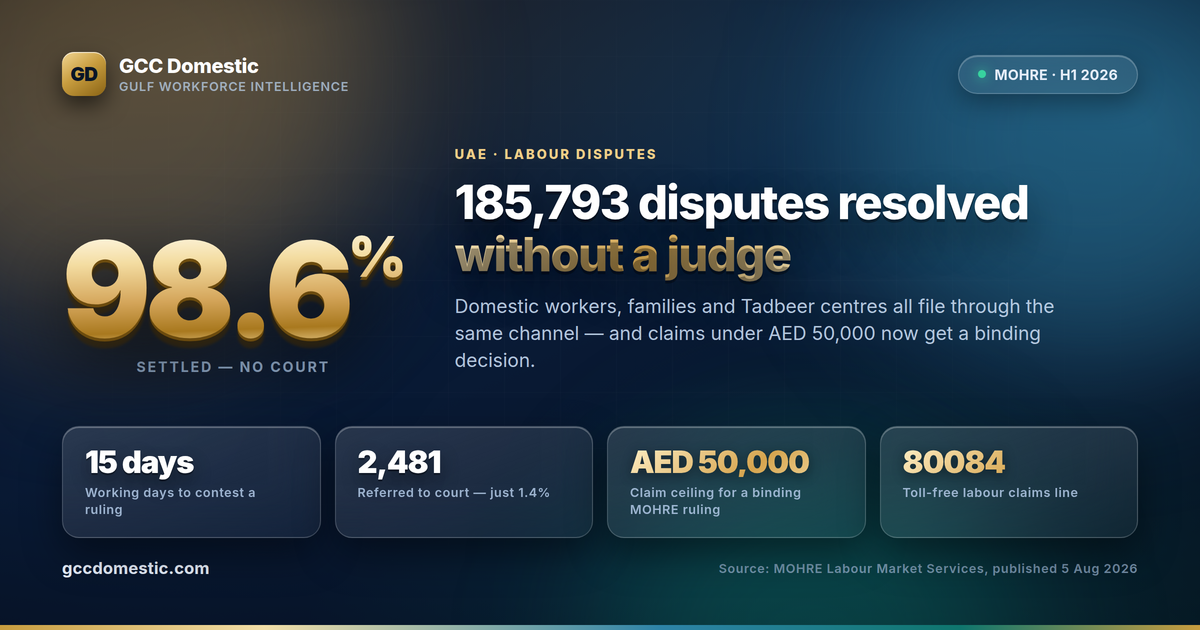
The UAE settled 185,793 labour disputes without sending them to court in the first half of 2026 — 98.6% of every case recorded. Only 2,481 disputes, 1.4% of the total, went to a judge. For a domestic worker owed two months of salary, or a family in a contract dispute with a Tadbeer centre, that ratio is the single most useful fact about how the UAE handles labour conflict.
This guide explains what those numbers actually mean, why the system changed in 2024, how a domestic worker or a sponsoring family files a claim, and the one deadline that quietly decides whether your case survives.
The numbers, plainly
The Ministry of Human Resources and Emiratisation released its Labour Market Services Sector results for January to June 2026.
| Disputes settled amicably (H1 2026) | 185,793 |
| Share resolved without court | 98.6% |
| Referred to the judiciary | 2,481 (1.4%) |
| Total recorded cases | 188,274 |
| Full-year 2025 amicable rate | 98.6% — the same |
| Collective disputes referred (2025) | 3 cases, 322 workers |
| Labour consultation contacts (2025) | ~9.43 million |
Two things stand out. The rate held steady across a full year and then a half year, which suggests a stable process rather than a good quarter. And the collective dispute count — three, in a labour market of millions — indicates that conflict is being caught individually, early, before it aggregates.
What changed in 2024, and why it matters more than the percentage
Before 2024, a labour dispute that could not be settled by mediation went to court. Mediation had no teeth: if the employer refused, the worker's only route was litigation they often could not afford to pursue.
Under Federal Decree-Law No. 20 of 2023, effective 1 January 2024, MOHRE gained the authority to issue a binding decision on labour disputes where the claim does not exceed AED 50,000. The Ministry stopped being a mediator and became a decision-maker.
That threshold is the reason the numbers look the way they do. Most domestic worker disputes — unpaid salary, end-of-service gratuity, an unreturned ticket, a contract terminated early — sit well under AED 50,000. They now get decided inside the Ministry, in weeks, at no filing cost to the worker.
The same authority applies above AED 50,000 in one situation: where either party fails to file before the competent Court of First Instance within 15 working days of being notified of the Ministry's decision.
Domestic workers are inside this system — not adjacent to it
This is the point most coverage skips, and the one that matters most to our readers.
MOHRE's dispute jurisdiction expressly covers three groups: private sector employees, domestic workers, and recruitment agencies. A housemaid, nanny, driver, cook or private nurse in the UAE files through the same channel as an office employee, and a family in dispute with a Tadbeer centre files through it too.
So does the reverse. A sponsoring family whose worker left without notice, or who is disputing a refund from a licensed centre, uses the same route rather than starting at court.
How to file — the actual steps
- Contact MOHRE first. Call the Labour Claims and Advisory Call Centre on 80084 (toll-free), or file through the MOHRE website or smart app. Court is not the first stop, and filing there first will usually send you back.
- State the claim in figures. Months unpaid, amount per month, dates. A specific claim moves; "they treated me badly" does not.
- Bring the contract. The MOHRE-registered contract is the reference document. If you hired through a Tadbeer centre, that contract is already in the system.
- Bring the payment record. Since domestic worker salaries moved onto the Wage Protection System, the transfer trail is the evidence. Cash payments with no record are the weakest position an employer can be in.
- A legal researcher reviews it. MOHRE staffs complaint handling with specialised legal professionals and works to prescribed timeframes.
- If the claim is under AED 50,000, the Ministry decides. The decision binds. It is not a suggestion.
- Watch the 15 working days. If you disagree with the decision and intend to contest it, you must file before the Court of First Instance within 15 working days of notification. Miss it and the Ministry's decision stands as final.
Why prevention is now doing most of the work
Ahmed Al Qara, Director of the Labour Relations Department at MOHRE, has pointed to the upgraded Wage Protection System as a major contributor — not because it resolves disputes, but because it stops them forming.
Under Ministerial Resolution No. 340 of 2026, in force since 1 June 2026, the first day of each calendar month is the unified salary due date across the private sector. Payment after that is classed as delayed. The escalation is automatic and dated: around day 16, MOHRE may register a labour dispute on the worker's behalf and suspend work permits for larger non-compliant employers; by day 21, more severe measures become available, including precautionary attachment, travel bans on responsible individuals, and referral to the Public Prosecutor.
The resolution names recruitment agencies and domestic worker recruitment offices among the sectors singled out for accelerated enforcement.
Read together, the design becomes clear. Wage delay is detected by system, not by complaint. The dispute is registered before the worker has to know how to register one. That is why the amicable settlement rate holds at 98.6% rather than drifting — a growing share of cases never becomes adversarial in the first place.
Reading the 98.6% honestly
The figure is real, verifiable, and internationally strong — the UAE ranks first in the IMD World Competitiveness Yearbook for the lowest incidence of labour disputes.
It also has a defined scope, and understanding that scope makes you better at using the system rather than less confident in it.
- It measures recorded disputes. It describes what happens to cases that enter the system. It cannot describe a grievance nobody filed.
- "Settled amicably" means resolved without judicial referral. It covers a full payout and a negotiated partial settlement alike.
- The rate is a process indicator, not an outcome audit. It tells you the machinery is fast and functioning — and it is. What you get out of it still depends on the strength of what you bring in.
The practical conclusion is not scepticism. It is the opposite: the system works well enough that filing is worth it, and documentation is what converts a working system into a resolved claim.
What this means if you sponsor a domestic worker
- Pay through WPS, on the first of the month. The transfer record is your defence. In a dispute, an employer with a clean payment trail is in a very different position from one without.
- Keep the registered contract as the single source of truth. Side agreements made verbally do not survive contact with a legal researcher.
- Do not hold the passport. It remains a violation and it converts an ordinary wage disagreement into a much worse case for you.
- Use 80084 before things escalate. The advisory line answers employer questions too, not only worker complaints.
- If you use a monthly or flexible Tadbeer package, the centre is the employer of record and WPS compliance sits with the centre — but your contract with the centre is still enforceable through the same channel.
What this means if you are a domestic worker
- You have a free, toll-free route to a binding decision: 80084. You do not need a lawyer for a claim under AED 50,000.
- Your salary should arrive electronically. If it does not, that gap is now visible to the Ministry on a dated schedule.
- You can end a contract immediately for serious employer breach — including delayed salary, abuse, or unsafe conditions — and file a complaint.
- Unpaid wages remain owed regardless of how the employment ends. Ending the job does not end the entitlement.
- Record what you can: dates, amounts, messages. The system rewards specificity.
Frequently asked questions
Do domestic workers have the same dispute rights as company employees in the UAE?
They use the same MOHRE dispute channel. The Ministry's jurisdiction expressly covers private sector employees, domestic workers, and recruitment agencies. The substantive entitlements come from the domestic labour law rather than the general labour law, but the route to resolution is shared.
How much does it cost to file a labour complaint with MOHRE?
Filing through the Labour Claims and Advisory Call Centre on 80084, the MOHRE website or the smart app carries no cost to the complainant. That is a substantial part of why 98.6% of cases resolve before court — the first step has no financial barrier.
What is the AED 50,000 threshold?
Since 1 January 2024, MOHRE can issue a binding decision on labour disputes where the claim value does not exceed AED 50,000. Above that figure, the dispute proceeds to the competent court, though the Ministry's process still applies first.
How long do I have to challenge a MOHRE decision?
Fifteen working days from notification of the decision, filed before the Court of First Instance. If neither party files within that window, the Ministry's decision stands.
What happens if my employer pays me in cash?
Domestic worker salaries in the UAE are required to be paid through approved electronic channels. Cash leaves no verifiable record, which weakens the employer's position in any dispute and is itself a compliance issue for the sponsor.
Can a family file against a Tadbeer centre?
Yes. Recruitment agencies and domestic worker recruitment offices fall inside MOHRE's dispute jurisdiction, and they are specifically named among the sectors receiving accelerated wage compliance enforcement under the 2026 WPS resolution.
Does 98.6% mean disputes are usually decided in the worker's favour?
No. It means 98.6% of recorded disputes are resolved without judicial referral. The figure measures how cases are concluded, not who wins. Outcome depends on the contract, the evidence, and the payment record.