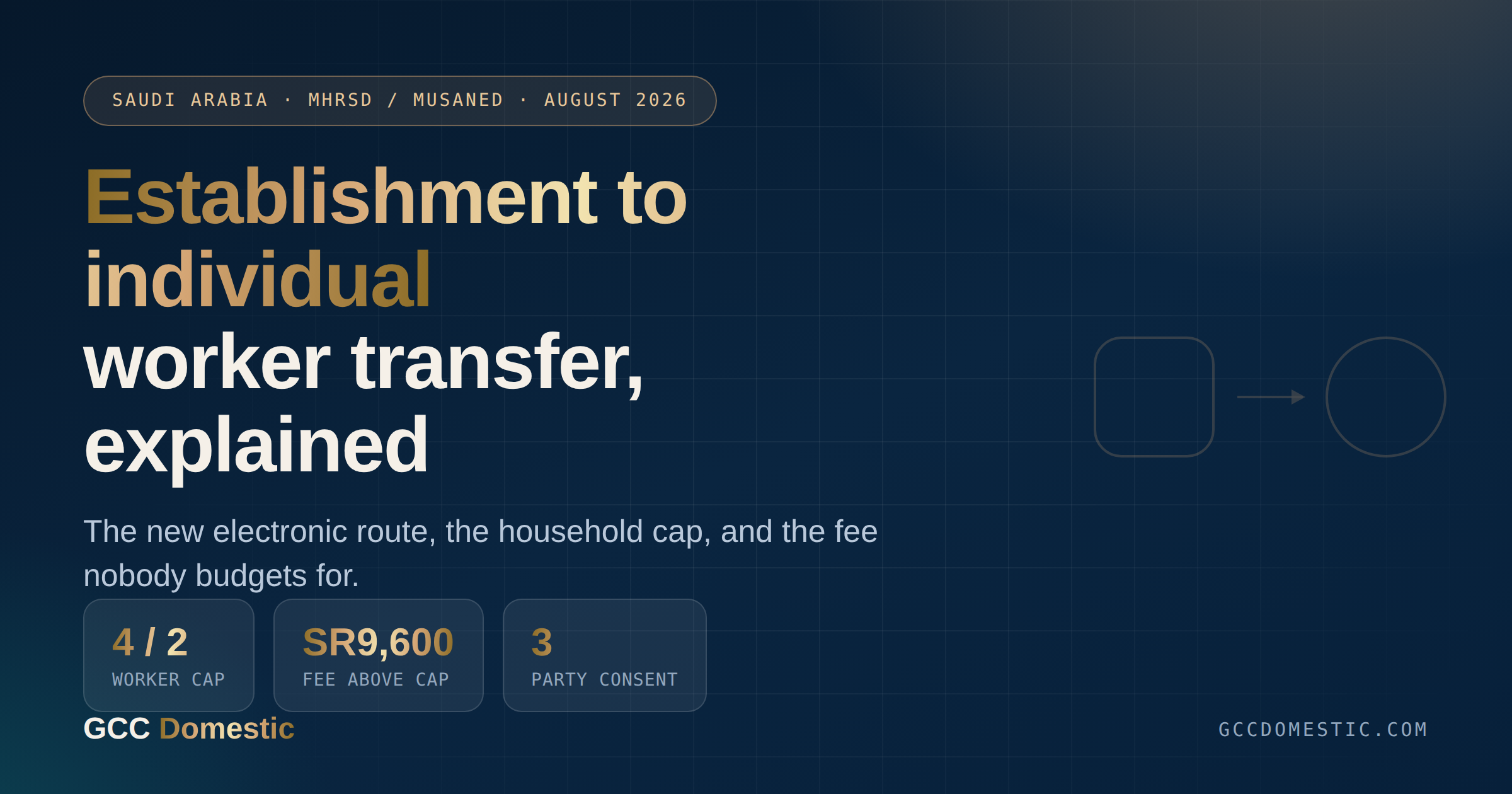
Saudi Arabia has opened a new electronic route allowing individuals to request the transfer of a worker’s services from a private-sector establishment to their own sponsorship. The service runs through the Ministry of Human Resources and Social Development’s platforms and is subject to a defined set of conditions and household limits.
For families, this matters for one practical reason: it is now possible to take on a worker already inside the Kingdom, employed by a company, without going through a fresh overseas recruitment cycle. But there is a limit on how many workers a household may hold, and exceeding it carries an annual fee.
What has actually changed
Transfers between individuals have been available on Musaned for some time. What is new is the establishment-to-individual direction being opened as a request an individual can initiate electronically, rather than a counter transaction.
The Ministry has framed this as part of continuing work to regulate the domestic labour sector, protect the rights of all parties to the contract, and bring transfer costs under control.
Note: detailed executive conditions were still being published at the time of writing. Confirm the current rules on Musaned or through MHRSD on 19911 before committing to any transfer.
The household cap — the number most people miss
Saudi Arabia limits how many domestic workers a single household may sponsor, and charges an annual fee above that limit.
| Saudi individual | Up to 4 domestic workers without additional charge |
| Resident (expatriate) sponsor | Up to 2 domestic workers without additional charge |
| Fee above the limit | SR9,600 per year, per additional worker |
| Exemptions | Humanitarian cases, including people with disabilities and those with chronic or serious illnesses |
This is the single most common reason a transfer request is rejected at the acceptance stage. The cap is checked against the receiving household, not the releasing party. If you are already at your limit, the transfer will not complete — or will complete and attach a recurring annual fee you did not budget for.
How a transfer works in practice
Whichever direction the transfer runs, the Saudi framework follows the same three-party logic. Nothing moves on one party’s say-so.
- The releasing party initiates or consents. In an establishment-to-individual transfer, the company holding the worker’s sponsorship must release them.
- The worker consents. This is not a formality. The worker approves or rejects the transfer through the platform, and a transfer cannot be completed over their objection.
- The receiving individual accepts. Eligibility is checked at this step — household cap, sponsor status, and any outstanding obligations.
- A new fixed-term contract is issued. Both parties approve a contract setting out wage, duration and obligations. The contract is the record, not a private arrangement.
- Fees are paid through approved channels. Payment runs through the platform’s accredited e-payment channels, within ministry-set limits.
Transfer fee ceilings between individuals
For individual-to-individual transfers, the Ministry publishes maximum fees by nationality. These have been set as follows:
| Ethiopia | SR10,023 |
| Burundi | SR10,457 |
| Sierra Leone | SR10,488 |
| Uganda | SR12,761 |
| Kenya | SR14,135 |
| Bangladesh | SR16,188 |
| Sri Lanka | SR18,336 |
| Philippines | SR19,270 |
| Indonesia | SR21,535 |
These are ceilings, not prices. Anyone asking for more than the published maximum for that nationality is overcharging, and the transaction should be running through the platform where the ceiling is enforced.
Salary payment is now mandatory through official channels
Any family taking on a worker by transfer inherits an obligation that took effect on 1 January 2026: domestic worker salaries in Saudi Arabia must be paid through approved electronic channels — participating banks or digital wallets on the platform.
Practically, that means the receiving sponsor sets up the payment method at the contract acceptance stage, so the first salary is paid electronically on the contractual payday. Cash payment is no longer compliant, and a documented payment record is what protects both sides if a dispute arises later.
What to check before accepting a transfer
- Your household count. How many workers are already under your sponsorship, and does adding one cross the cap?
- Outstanding dues on the worker. Unpaid wages or an unsettled end-of-service entitlement from the previous employer do not disappear on transfer. Establish what is owed and by whom before signing.
- The contract terms. Wage, duration, rest day, and duties. If the role or salary differs from the worker’s original contract, some source countries require the new contract to be attested at their embassy.
- Absence reports. An active absconding report against the worker will block a standard transfer until it is resolved or cancelled.
- The releasing party’s licence status. Confirm the establishment is properly licensed. A release from an entity that is not in good standing creates problems downstream.
Why the Ministry is opening this route
Two reasons sit behind it, and both are visible in the platform data.
Individual-to-individual transfers have grown sharply — in one recent comparison period, requests rose to roughly 229,000 from 113,000 a year earlier. Establishment-to-individual requests over the same window were around 8,559, a fraction of the total. Opening that direction properly addresses a real bottleneck.
The second reason is cost control. Every transfer that happens inside the platform is a transfer where the fee ceiling applies, the contract is documented, and the payment is traceable. Transfers arranged privately are where overcharging and unrecorded arrangements occur.
Frequently asked questions
Can I transfer a worker from a company to my own sponsorship?
Yes. Saudi Arabia has opened an electronic route for individuals to request exactly this, subject to conditions and the household cap. Confirm current requirements on Musaned before proceeding.
How many domestic workers can one household sponsor?
Up to four for a Saudi individual and up to two for a resident sponsor, without additional charge. Above that, an annual fee of SR9,600 applies per additional worker, with exemptions for humanitarian cases.
Does the worker have to agree to the transfer?
Yes. The worker’s approval is a required step in the process. A transfer cannot be completed without it.
How much does a transfer cost?
For individual-to-individual transfers, ceilings are set by nationality — from around SR10,023 for Ethiopian workers up to SR21,535 for Indonesian workers. These are maximums, and payment runs through approved channels.
Do I still have to pay salary electronically?
Yes. Since 1 January 2026, domestic worker salaries must be paid through approved electronic channels. This applies to workers acquired by transfer in the same way as newly recruited workers.
What happens to unpaid wages from the previous employer?
They remain owed. Transfer does not extinguish an entitlement. Establish the position in writing before accepting the transfer, and raise unresolved amounts with MHRSD rather than absorbing them.